
INTRODUCTION:
What is Antimatter, and where did it come from? The story of antimatter begins at the very start of the universe, around 13.8 billion years ago, during the Big Bang. At that moment, the universe was born from an intense burst of energy, creating both matter and antimatter in almost equal amounts. These two were like mirror opposites when they met; they instantly destroyed each other, releasing pure energy. This raises a fascinating question: if matter and antimatter were equal, why didn’t everything turn into energy? Why do we still see matter all around us today? Scientists are still searching for this answer, making it one of the biggest mysteries in modern physics.
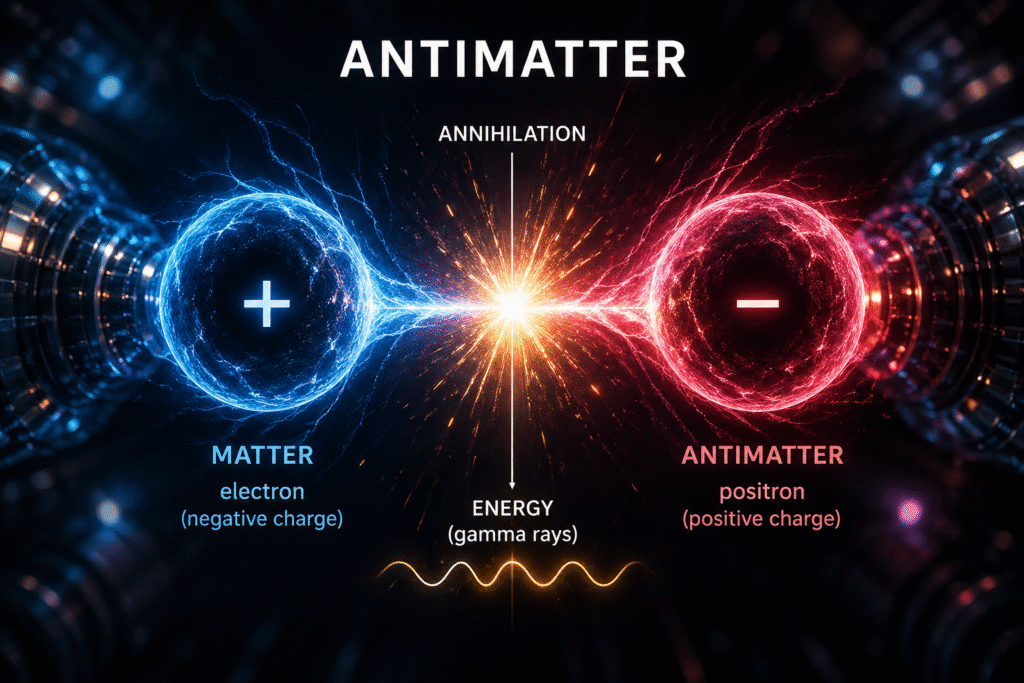
At a basic level, antimatter is made of particles that have the same mass as normal matter but opposite properties, such as electric charge. For example, an electron has a negative charge, while its antimatter version, the positron, has a positive charge. Similarly, protons and antiprotons are identical in mass but opposite in charge. Matter is made of particles like electrons, protons, and neutrons, while antimatter is made of positrons, antiprotons, and antineutrons. When these particles collide, they annihilate each other and release a huge amount of energy, as explained by Einstein’s mass–energy equivalence. Although most antimatter disappeared shortly after the Big Bang, small amounts are still created naturally through cosmic rays and artificially in advanced laboratories, showing that antimatter is not just a theory; it is a real and powerful part of our universe.
HOW SCIENTISTS CREATE ANTIMATTER:
Scientists became deeply interested in antimatter when they realized it could release extremely high energy during annihilation with matter. This wasn’t just about creating a “100% efficient energy source” that idea is actually misleading. The real motivation was to understand the universe itself: why it is dominated by matter, how the laws of physics work at a fundamental level, and whether antimatter could have future technological uses. These questions pushed researchers to design advanced experiments to produce antimatter artificially on Earth.
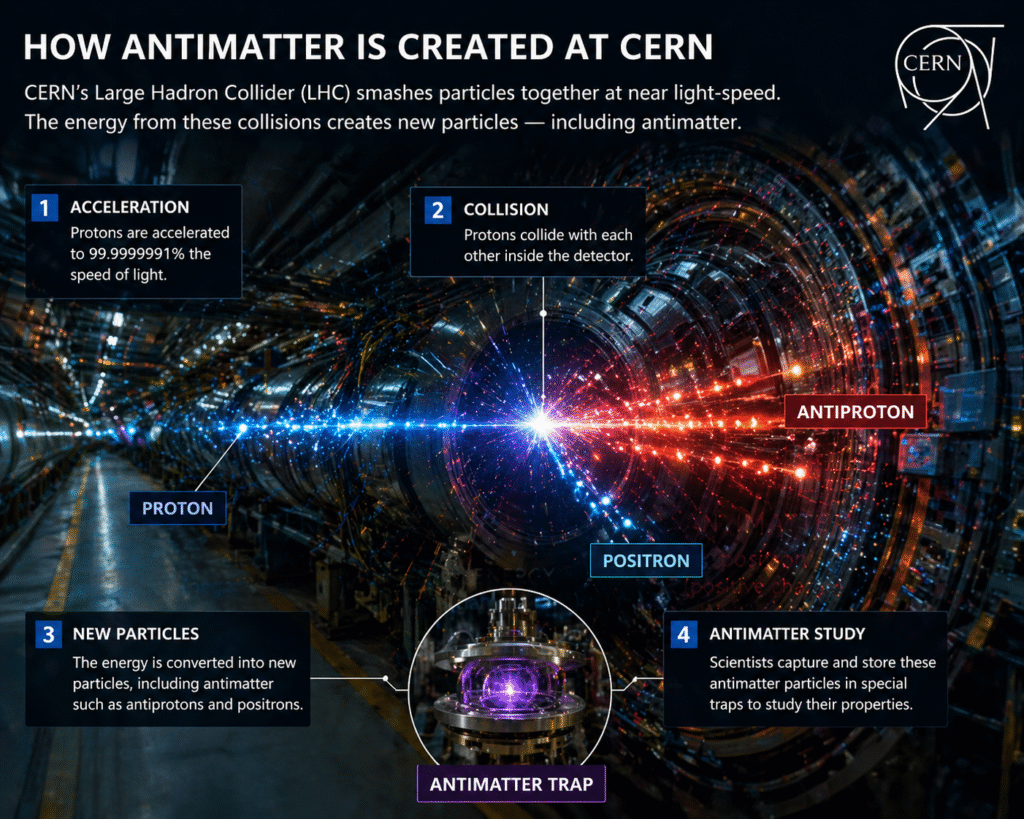
A major breakthrough came at CERN, one of the world’s largest research centers. There, scientists use powerful particle accelerators to recreate conditions similar to those just after the Big Bang. In these experiments, particles are accelerated to near light speed and smashed together, releasing enormous energy. According to Albert Einstein’s mass–energy equivalence principle, this energy can transform into matter and antimatter particles, such as antiprotons and positrons. Scientists then carefully combine these particles to form anti-atoms like antihydrogen, though this process is extremely delicate because antimatter instantly annihilates upon contact with normal matter.
However, producing antimatter comes with serious challenges. The biggest issue is cost and energy consumption. Scientists can only create incredibly tiny amounts just nanograms over many years. For example, the total antimatter ever produced at CERN would only power a small light bulb for a few hours. Even more surprisingly, creating antimatter requires far more energy than it releases. While 1 gram of antimatter could release about 9×10139 \times 10^{13}9×10¹³ joules of energy, producing that same amount would require vastly more energy than the entire world generates in a year, making it impractical as an energy source.
Another major problem is storage. Since antimatter cannot touch normal matter, it cannot be stored in ordinary containers. Scientists use magnetic traps to hold antimatter particles suspended in space, preventing contact. Even then, antimatter is highly unstable and exists only for short periods, making it difficult to study. Despite these challenges, research continues because antimatter could help answer deep questions about the universe and may one day contribute to advanced technologies like space propulsion. It remains one of the most fascinating and mysterious fields in modern science.
FUTURE USE OF ANTIMATER:
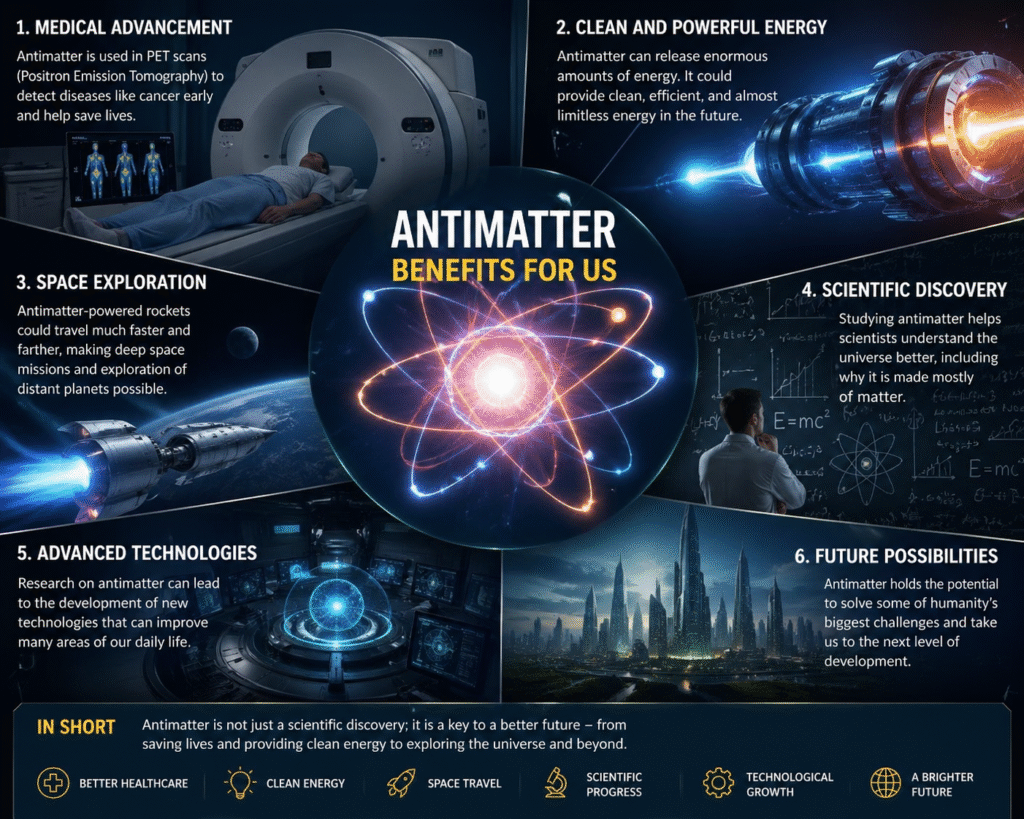
Antimatter has the potential to significantly change the future because of the enormous energy it can release. When antimatter comes into contact with normal matter, both particles annihilate each other and convert their entire mass into pure energy, following mass–energy equivalence discovered by Albert Einstein. This process makes antimatter far more energy-dense than traditional fuels such as coal, oil, or even nuclear fuel. For example, the annihilation of just 1 gram of antimatter with 1 gram of normal matter could produce around 43 kilotons of TNT equivalent energy, which is significantly more powerful than the approximately 15-kiloton explosion of the Atomic bombings of Hiroshima and Nagasaki. This demonstrates how powerful antimatter truly is.
Although antimatter sounds like science fiction, it is already being used in limited but valuable ways. One important example is in medicine through PET scans (Positron Emission Tomography), where positrons small antimatter particles help doctors detect diseases such as cancer inside the human body. This proves that antimatter is not only a theoretical concept but also a practical tool that is already helping save lives today. In the future, antimatter could also revolutionize space travel. Organizations like NASA have studied the possibility of antimatter-powered spacecraft. Because antimatter releases an extraordinary amount of energy, it could enable spacecraft to travel much faster than modern rockets, making deep-space missions and exploration of distant planets or even other star systems more realistic.
In addition to medicine and space exploration, antimatter research could help scientists discover new laws of physics and better understand why the universe is made mostly of matter instead of equal amounts of matter and antimatter. These discoveries may lead to technologies that are currently beyond human imagination. However, it is important to remain realistic. Today, antimatter is extremely expensive to produce, very difficult to store, and highly dangerous if not handled properly. Because of these challenges, its large-scale use in energy production or transportation is still far in the future. Even with these limitations, antimatter remains one of the most promising and fascinating fields of modern science, with the potential to transform medicine, energy, and space exploration in the years ahead.
HOW ANTIMATTER CAN BE DANGEROUS:
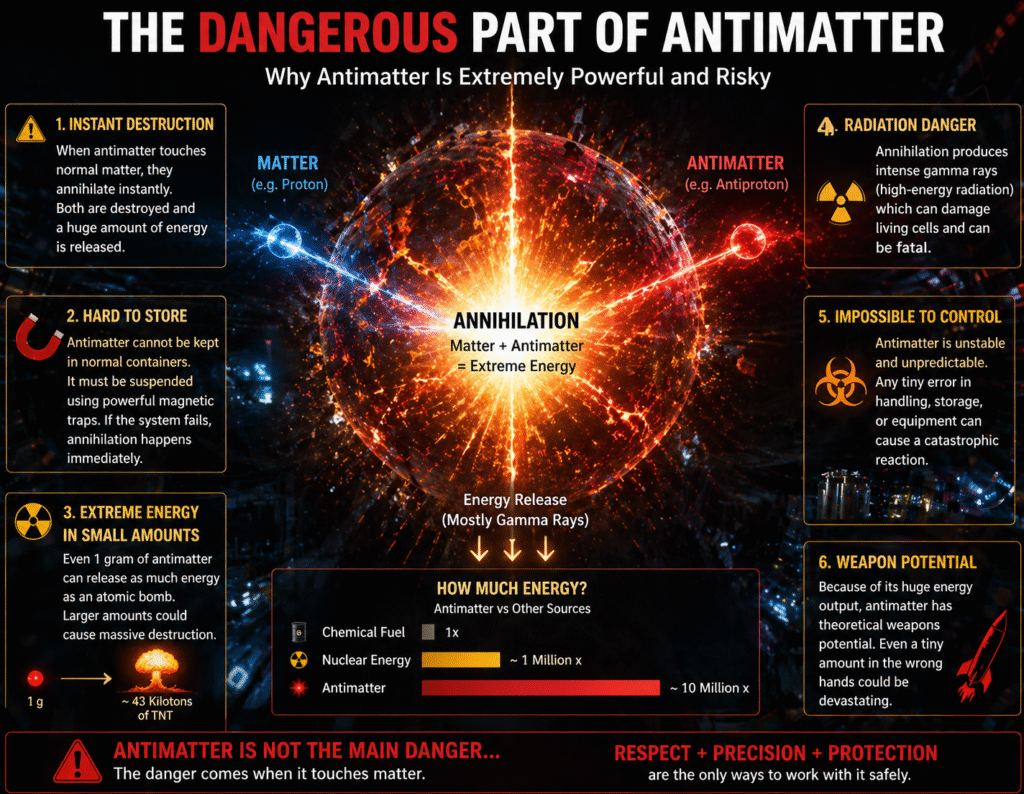
Antimatter is considered dangerous mainly because of what happens when it comes into contact with normal matter. When even a tiny particle of antimatter touches matter, both are instantly destroyed in a process called annihilation. This reaction releases an enormous amount of energy, explained by mass–energy equivalence discovered by Albert Einstein. Because nearly all the mass is converted into energy, the release is far more powerful than chemical reactions and even more efficient than nuclear reactions. In theory, even a very small amount of antimatter could cause massive destruction, making it seem more dangerous than conventional explosives.
Another major reason antimatter is dangerous is the difficulty of storing it safely. It cannot be kept in normal containers because contact with any material surface would immediately trigger annihilation. Scientists instead use advanced magnetic traps to hold antimatter particles in place without physical contact. These systems, developed in laboratories such as CERN, are highly complex and must operate perfectly at all times. If the containment system fails, the antimatter would instantly react with surrounding matter, releasing its energy in a sudden burst. This makes handling antimatter extremely delicate and technically challenging, requiring highly controlled environments.
However, it is important to stay realistic about the actual risk. Antimatter is incredibly rare, extremely expensive to produce, and currently exists only in tiny amounts under strict scientific control. It is not something that can be easily stored, transported, or used outside specialized facilities. While its theoretical potential makes it seem very dangerous, in reality, it is carefully managed and far from being a practical threat. Instead, scientists continue to study antimatter for its valuable applications in medicine, physics research, and future technologies.
CONCLUSION:
Antimatter is one of the most fascinating and remarkable discoveries in modern science. From its origin in the Big Bang to its recreation in advanced laboratories like CERN, antimatter has helped scientists explore some of the deepest mysteries of the universe. Its ability to release enormous energy, explained by Albert Einstein’s mass–energy equivalence, makes it both incredibly powerful and potentially dangerous. However, we are still not capable of producing antimatter on a large scale or reducing its extremely high cost.
Even so, the future of antimatter research holds great promise. With more discoveries, advanced technology, and passionate scientists, what seems impossible today could become reality tomorrow. In the past, people believed that space travel was impossible, yet today humanity is exploring beyond our solar system. In the same way, if antimatter production becomes practical, it could transform the world and take human development to an entirely new level.
KNOW MORE:
INTERNAL LINKS:
https://techman.live/best-free-platforms-to-learn-coding-in-2026/
https://techman.live/top-5-tech-jobs-in-the-next-decade-that-will-dominate-the-future/
EXTERNAL LINKS: