
INTRODUCTION:
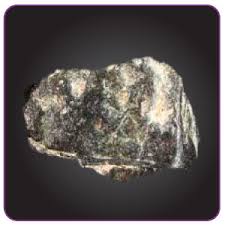
India’s progress in the second stage of its thorium-based nuclear program is being called a major milestone, but for many, it’s not immediately clear why it matters. The real story goes far beyond a single achievement; it’s about long-term strategy, patience, and scientific vision. Unlike countries rich in uranium, India has limited reserves of this key nuclear fuel. Since uranium is essential for most conventional reactors and even nuclear defense capabilities, this could have slowed India’s growth. Instead, it pushed the nation to think differently. Guided by the vision of Homi J. Bhabha, India chose to turn its limitation into a strength by focusing on thorium, an element it has in abundance.
This led to the creation of India’s unique three-stage nuclear program. Thorium cannot be used directly as fuel, which is why a step-by-step process is required to unlock its energy potential. In the second stage, reactors are designed to produce materials that eventually make thorium usable as a powerful energy source. Once fully developed, this strategy could provide India with energy security for hundreds of years, reducing dependence on imports and transforming it into a self-reliant energy powerhouse. This isn’t just about nuclear energy; it’s about building a future where India’s growth is powered by its own resources.
HISTORY:
The history of India’s three-stage nuclear program begins with the vision of Homi J. Bhabha, often called the father of India’s nuclear energy program. Born in 1909, Bhabha was a brilliant physicist who studied at the University of Cambridge, where he worked on advanced nuclear physics. At a time when nuclear science was still in its early stages, he clearly saw its future potential not only as a destructive force in weapons that could wipe out cities in seconds, but also as a powerful source of energy that could transform nations. He believed that this immense energy could be used for development, progress, and the long-term growth of countries like India.
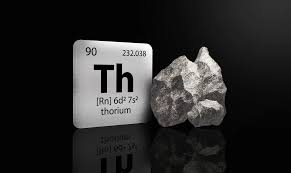
When Bhabha returned to India, he was determined to make the nation energy independent for generations. However, he faced a major challenge: India had very limited reserves of uranium, the primary fuel used in most nuclear reactors. Instead of seeing this as a barrier, Bhabha turned it into an opportunity. He identified that India possessed nearly a quarter of the world’s thorium reserves, an element with huge potential, but one that cannot be used directly as fuel. Through deep research and strategic thinking, he developed the idea of the three-stage nuclear program, a long-term plan where India would first use uranium, then gradually produce materials needed to unlock thorium’s energy potential.
Turning this vision into reality was not easy. In the early years after independence, India lacked funding, infrastructure, and advanced technology. Many experts doubted whether such an ambitious program could succeed. Despite these obstacles, Bhabha received strong support from leaders like Jawaharlal Nehru, who believed that science and technology were essential for building a strong nation. With this backing, Bhabha established key institutions such as the Tata Institute of Fundamental Research in 1945, followed by the Atomic Energy Commission of India in 1948, and later the Bhabha Atomic Research Centre in Mumbai. These institutions became the foundation of India’s nuclear capabilities.
Although progress was slow and filled with challenges, including international restrictions, limited resources, and technological barriers, Bhabha never gave up. He remained committed to his vision of making India energy independent through thorium. Today, as India moves into the second stage of this program, it represents not just a scientific milestone but the realization of a bold vision that began decades ago with determination, patience, and extraordinary foresight.
THE THREE-STAGE NUCLEAR PROGRAM:
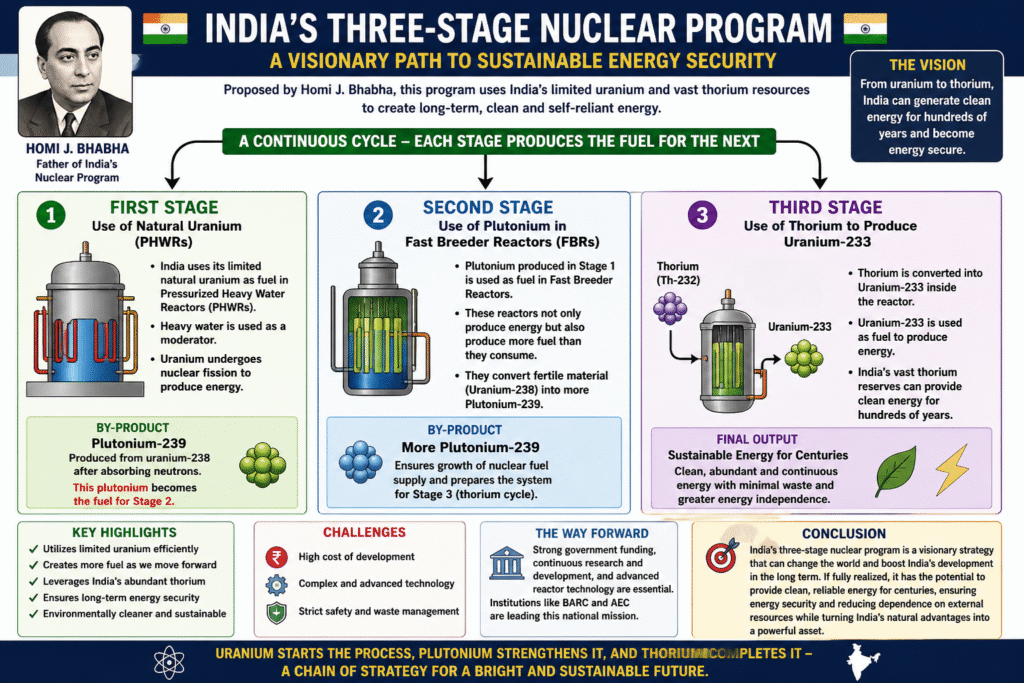
India’s three-stage nuclear program is a carefully designed long-term strategy to overcome its limited uranium resources and eventually shift toward using thorium as a sustainable energy source. This visionary idea was first proposed by Homi J. Bhabha, who laid the foundation for a system in which each stage is interconnected. In this program, the output or byproduct of one stage becomes the fuel for the next, creating a continuous and efficient cycle of energy production. The first stage uses natural uranium, whose byproducts are then processed to support the second stage, and so on, ultimately enabling the use of abundant thorium reserves. This integrated approach ensures long-term energy security for India while maximizing resource efficiency.
STAGE 1: PRESSURIZED HEAVY WATER REACTOR
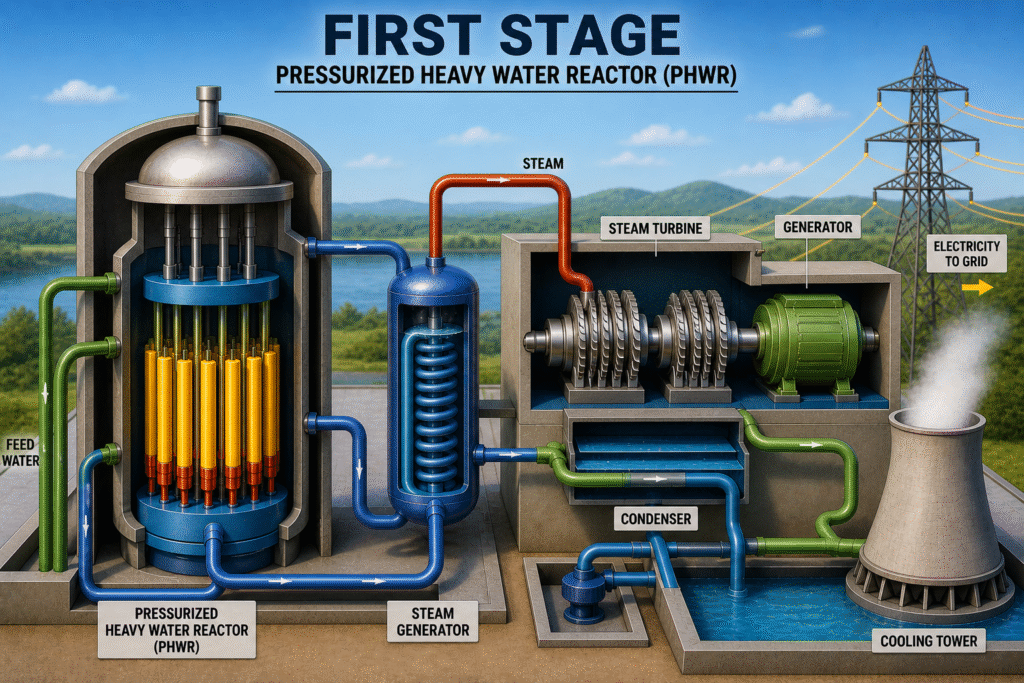
The first stage of India’s three-stage nuclear program is based on the use of natural uranium in reactors called Pressurized Heavy Water Reactors (PHWRs). In this stage, India utilizes its limited uranium reserves as fuel, while heavy water is used as a moderator to control the nuclear reaction efficiently. When uranium undergoes nuclear fission inside the reactor, it releases a large amount of energy that is used to generate electricity.
At the same time, this process produces an important byproduct called plutonium-239, formed from uranium-238 after absorbing neutrons. This plutonium is crucial because it serves as the primary fuel for the program’s second stage. India has already successfully developed and operated many PHWRs, making this stage the most advanced and well-established part of its nuclear energy strategy.
STAGE 2: FAST BREEDER REACTORS
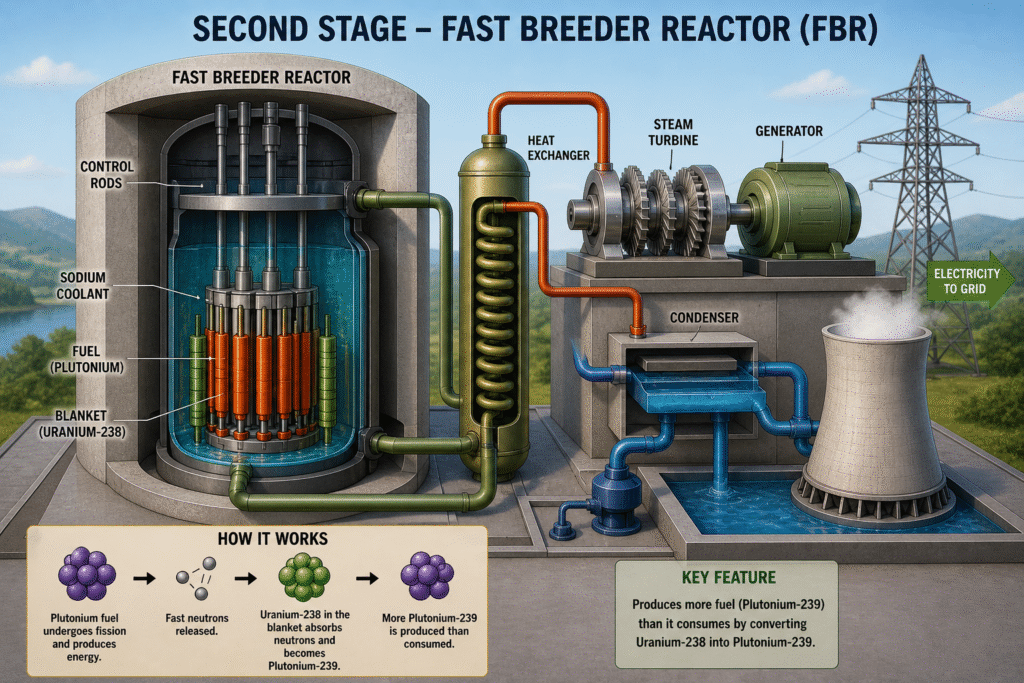
The second stage of India’s three-stage nuclear program is more advanced and centers on the use of plutonium produced in the first stage as fuel in Fast Breeder Reactors (FBRs). These reactors are unique because they not only generate energy but also produce more fuel than they consume. In this process, plutonium undergoes fission to release energy, while surrounding materials help sustain and enhance the reaction.
A key feature of this stage is the conversion of fertile material like uranium-238 into additional plutonium-239, effectively expanding India’s nuclear fuel supply. This makes the system highly efficient and self-sustaining over time. The second stage is also important because it prepares the foundation for the final stage, where thorium will be used. India is actively progressing in this phase, with fast breeder reactor projects under development to move closer to a long-term, sustainable nuclear energy future.
STAGE 3: THORIUM-BASED REACTOR
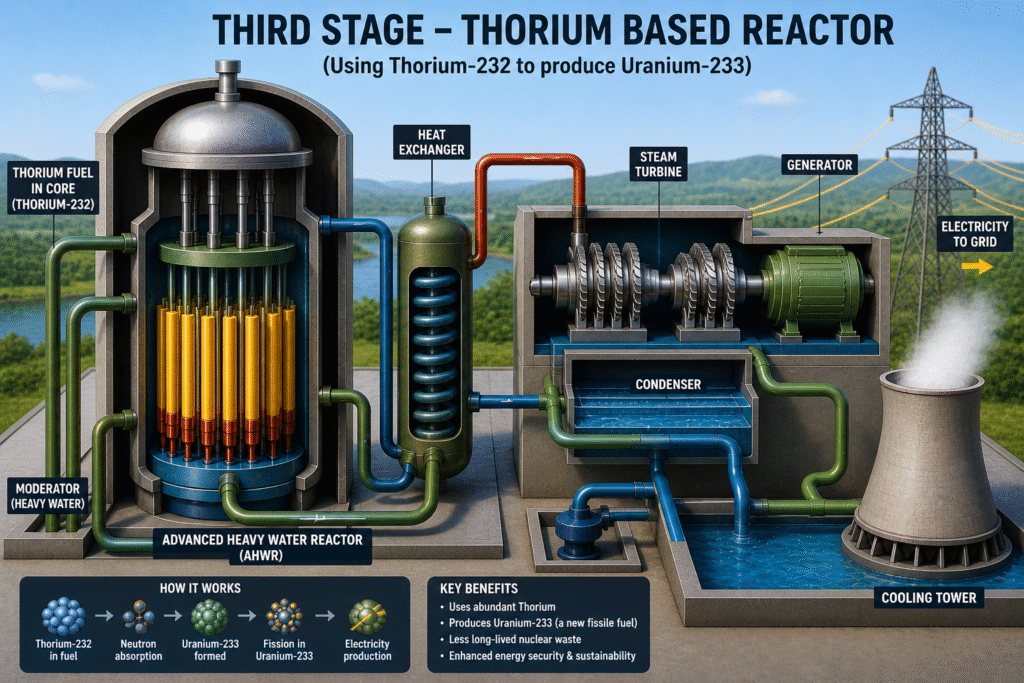
The third stage is the final and most important phase of India’s three-stage nuclear program. In this stage, thorium is used to produce uranium-233, which acts as the main nuclear fuel. Since thorium cannot be used directly in reactors, it must first be converted inside a reactor system. Once this conversion cycle is established, India can tap into its vast thorium reserves to generate large amounts of energy sustainably.
This stage has the potential to provide clean and long-lasting energy for hundreds of years, significantly reducing dependence on imported fuels. However, India’s success in reaching this stage depends on mastering each previous stage step by step. It requires strong research, advanced reactor technologies, and continuous fuel recycling to maintain an efficient and stable nuclear cycle.
Leading institutions like the Bhabha Atomic Research Centre and the Atomic Energy Commission of India are driving this effort forward. Although challenges such as high costs, complex technology, and strict safety requirements still exist, steady progress is being made. In simple terms, this program works like a strategic chain: uranium begins the process, plutonium strengthens it, and thorium completes it, potentially making India energy secure for centuries.
CONCLUSION:
In conclusion, India’s three-stage nuclear program is a highly visionary strategy that has the potential to transform the country’s energy future and support long-term development. Proposed by Homi J. Bhabha, it follows a step-by-step approach where each stage builds on the previous one: uranium begins the process, plutonium strengthens it, and thorium completes it. By linking these stages efficiently, India aims to create a sustainable, self-reliant, and long-lasting energy system.
However, this program also faces important challenges, especially high costs and the need for strong government funding and continuous research. Advanced technology, infrastructure, and innovation are essential to make it successful and reduce production costs over time. If fully achieved, this program can provide clean and reliable energy for centuries, ensure energy security, reduce dependence on imports, and turn India’s natural resources into a powerful advantage.
KNOW MORE:
INTERNAL LINKS:
https://techman.live/best-free-platforms-to-learn-coding-in-2026/
https://techman.live/what-is-antimatter-the-mysterious-energy-that-could-change-the-future/
EXTERNAL LINKS:
https://en.wikipedia.org/wiki/India%27s_three-stage_nuclear_power_programme